
Quickpost | 4 January 2026
In the pre‑dawn hours of 3 January 2026, a breathtaking chapter in modern geopolitics unfolded.
Across Venezuela’s capital, Caracas, explosions ripped through the night. U.S. military aircraft streaked across the sky in a meticulously planned offensive — part of what Washington called Operation Absolute Resolve. Within hours, Venezuelan President Nicolás Maduro and his wife, Cilia Flores, were captured by U.S. forces and flown out of the country, touching down in New York City under heavy security.
Military Precision in the Night
In a coordinated strike involving U.S. special forces, airpower, and intelligence assets, elite units breached Maduro’s fortified residence in Caracas. The operation — involving elements such as Delta Force, Army aviation, and support from multiple branches of the U.S. military — was reportedly rehearsed months in advance with help from CIA intelligence.
Around 2:01 a.m. local time, airstrikes targeted strategic military sites and key defensive positions. By 4:29 a.m., Maduro and Flores were in U.S. custody.
The U.S. president publicly confirmed the operation, broadcast on social media and news outlets: Maduro had been “captured,” the U.S. would “run” Venezuela, and the two would face charges on U.S. soil.
A Leader in Custody
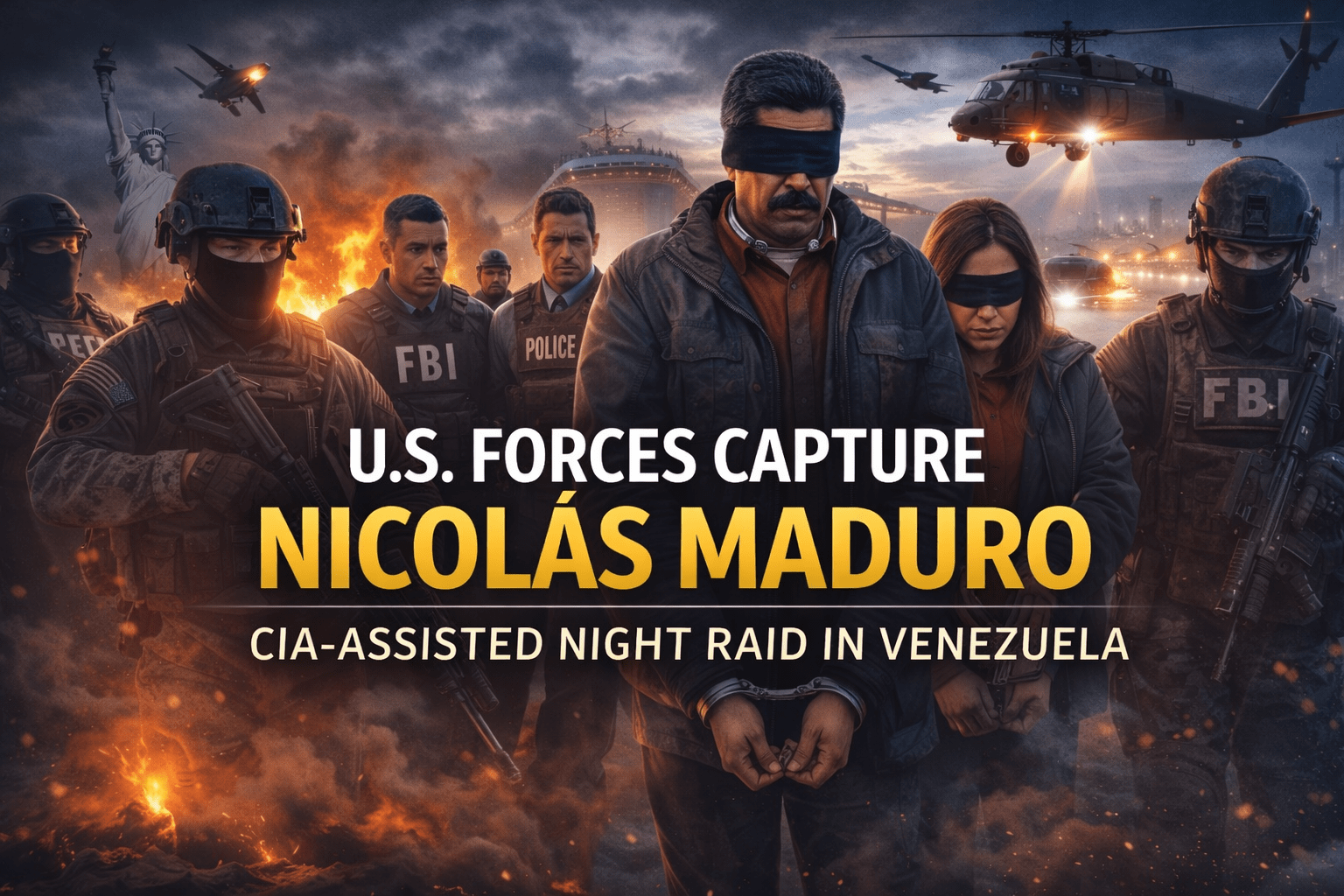
Footage began circulating shortly after the operation: Maduro, handcuffed and blindfolded, being escorted by federal agents. Later still, a brief video showed him in U.S. custody, offering a weary but defiant “Happy New Year” to authorities — a surreal moment underscoring the drama of the capture.
Maduro and Flores were first taken aboard the aircraft carrier USS Iwo Jima and then transported to Stewart Air National Guard Base before being handed over to law enforcement for processing.
U.S. officials have publicly stated they intend to try Maduro and Flores on narcotics‑related charges, including allegations of “narco‑terrorism conspiracy” and other crimes.
Washington’s Justification vs. Critics’ Outrage
President Donald Trump portrayed the strike as a decisive blow against narco‑crime and corruption. He declared that U.S. forces would oversee Venezuela’s transition and manage critical infrastructure — especially its vast oil resources— until conditions for a “proper transition” are established.
But global reactions have been sharply divided:
- Venezuelan Vice President Delcy Rodríguez denounced the raid as an unprecedented act of aggression and demanded proof of life for Maduro.
- Regional powers like China blasted the operation as a violation of international law.
- Legal scholars and international bodies warn that abducting a foreign head of state may breach the principles of sovereignty and global norms.
Critics fear the operation sets a dangerous precedent — one that could unravel established international rules and invite future forceful interventions by powerful states.
Chaos, Resistance, and a Nation in Flux
In Venezuela itself, the situation remains tense.
Streets in Caracas fell quiet under a tense calm, even as Maduro loyalists and opposition supporters debated the future. Some celebrated the end of Maduro’s era; others viewed the action as imperial overreach.
Opposition leader María Corina Machado, recognized by some as a transitional leader, hailed the moment as a turning point for Venezuela’s future.
Yet uncertainty reigns. The constitutional void left by Maduro’s removal, shifting leadership claims, and the specter of foreign military occupation have left the nation deeply unsettled.
A New Chapter — or a Dangerous Precedent?
The audacity of the operation — capturing a sitting president on foreign soil — has not only reshaped Venezuelan politics but also thrust U.S. foreign policy into uncharted territory.
Questions now loom large:
- Will the U.S. maintain control, and for how long?
- What legal framework enables the capture of a sovereign head of state?
- And how will the world react as this bold intervention unfolds?
One thing is clear: the capture of Nicolás Maduro has reverberated far beyond Caracas and Washington — it has sent shockwaves through international relations, global law and the fragile balance of sovereignty in the 21st century.
Sources (with links):
- Reuters – U.S. captures Venezuelan president Maduro:https://www.reuters.com/world/us/venezuelas-maduro-custody-trump-says-us-will-run-country-2026-01-04/
- Reuters – Inside the U.S. operation to capture Maduro (Operation Absolute Resolve):https://www.reuters.com/business/aerospace-defense/mock-house-cia-source-special-forces-us-operation-capture-maduro-2026-01-03/
- Al Jazeera – Live updates and details on Maduro’s capture:https://www.aljazeera.com/news/liveblog/2026/1/3/live-venezuelas-maduro-arrives-in-new-york-after-capture
- Wikipedia – U.S. case and custody of Nicolás Maduro:https://en.wikipedia.org/wiki/United_States_of_America_v._Nicol%C3%A1s_Maduro
- Wikipedia – 2026 United States strikes in Venezuela (Operation Absolute Resolve):https://en.wikipedia.org/wiki/2026_United_States_strikes_in_Venezuela