

Quickpost | Austin, Texas
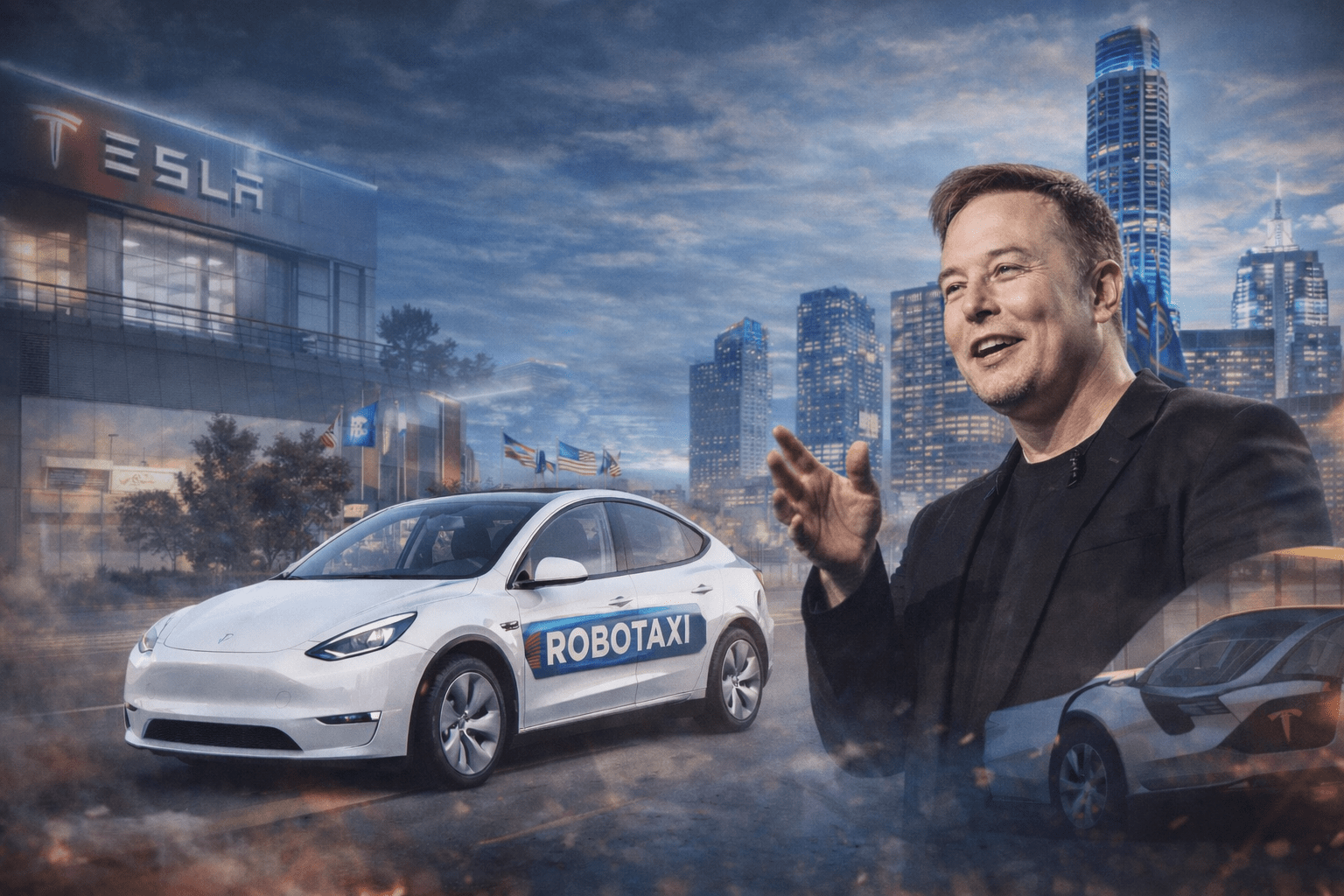
Tesla has officially expanded its much-anticipated robotaxi service in Austin, Texas. From January 22, 2026, the company has begun carrying passengers without any safety driver or onboard monitor, marking the first time Tesla has operated a fully unsupervised autonomous ride service.
The service currently uses Model Y vehicles, running entirely on Tesla’s Full Self-Driving (FSD) system.
How the robotaxi rollout began
Tesla CEO Elon Musk confirmed the launch in a video shared on social media, stating that robotaxis are now operating in Austin with no human driver present.
The rollout has started with a limited number of vehicles. Tesla’s Head of AI, Ashok Elluswamy, said the launch follows a gradual rollout strategy, with plans to integrate the service into a much larger fleet over time.
According to Tesla, the robotaxis are currently operating only on pre-approved, secure routes within the city.
How Tesla robotaxi works
Tesla’s robotaxi system relies entirely on a camera-based vision system and AI neural networks.
Operational process:
- The vehicle continuously scans its surroundings using cameras
- Identifies roads, vehicles, and pedestrians
- Uses AI to make real-time driving decisions and optimize routes
- Users request a ride through an app
- The car arrives at the pickup point autonomously
- Doors unlock automatically and payment is deducted digitally at drop-off
No steering wheel or human driver intervention is required.
Safety measures and Tesla’s claims
Elon Musk claims Tesla’s robotaxis are ten times safer than human-driven vehicles.
Safety systems include:
- Geofencing: vehicles are restricted to specific approved areas
- Remote monitoring: Tesla staff supervise operations from control centers
- Real-time AI decision-making
During the initial phase, the service is limited to designated safe zones in Austin.
What’s next: Cybercab production
Tesla has announced that production of its purpose-built robotaxi vehicle, Cybercab, will begin in April 2026 at the Austin Gigafactory.
Cybercab highlights:
- Designed exclusively for robotaxi operations
- Production cost expected to be under $30,000
- Steering-wheel-free design
Investment firm Morgan Stanley estimates Tesla could have more than 1,000 robotaxis on the road by the end of 2026.
Why this matters
Industry experts say the launch of a fully unsupervised robotaxi service represents:
- A major technological milestone for Tesla
- A potential disruption to the global ride-hailing market
- A significant challenge to companies like Uber and Lyft
It signals that Tesla has moved its Full Self-Driving technology into a real-world commercial phase.
Background
Tesla first announced plans to launch robotaxis in Austin in June 2025, though operations were limited at the time. By January 2026, the company has now entered what it calls a fully autonomous operational stage.
Analysts view this development as a clear indicator of how future urban transportation may evolve.
Sources
- CNBC – Everything we know about Tesla’s robotaxi launch in Austin https://www.cnbc.com
- CNBC – Elon Musk says Tesla robotaxi rides in Austin set to begin https://www.cnbc.com
- The Guardian – Tesla set to unveil self-driving car service in Austin https://www.theguardian.com
- Not a Tesla App – Tesla’s roadmap for 2026 https://www.notateslaapp.com
- Yahoo Finance – Tesla stock pops as Elon Musk posts robotaxi video https://finance.yahoo.com