
QuickPost | London | January 17, 2026
Global political and trade tensions escalated sharply after former US president Donald Trump announced plans to impose sweeping tariffs on several European countries over their opposition to US control of Greenland.
In a series of statements posted on his Truth Social platform, Trump said eight European nations—Denmark, Norway, Sweden, the United Kingdom, France, Germany, the Netherlands, and Finland—would face a 10% tariff on all goods exported to the United States starting 1 February, with the rate set to increase to 25% from 1 June.
Trump claimed the tariffs would remain in place until an agreement is reached for the “complete and total purchase of Greenland,” describing the situation as a matter of US national and global security.
Tariffs Linked to Greenland Standoff
Trump accused the European countries of deploying troops to Greenland and interfering with what he described as legitimate US security interests in the Arctic region.
Calling the situation “dangerous,” he warned that rival powers such as China and Russia were seeking influence over Greenland and insisted that Denmark had “no ability to stop” the United States from acting.
The announcement has triggered widespread concern among European leaders, who view the move as an unprecedented attempt to use trade pressure to influence territorial sovereignty.
Protests Erupt in Denmark and Greenland
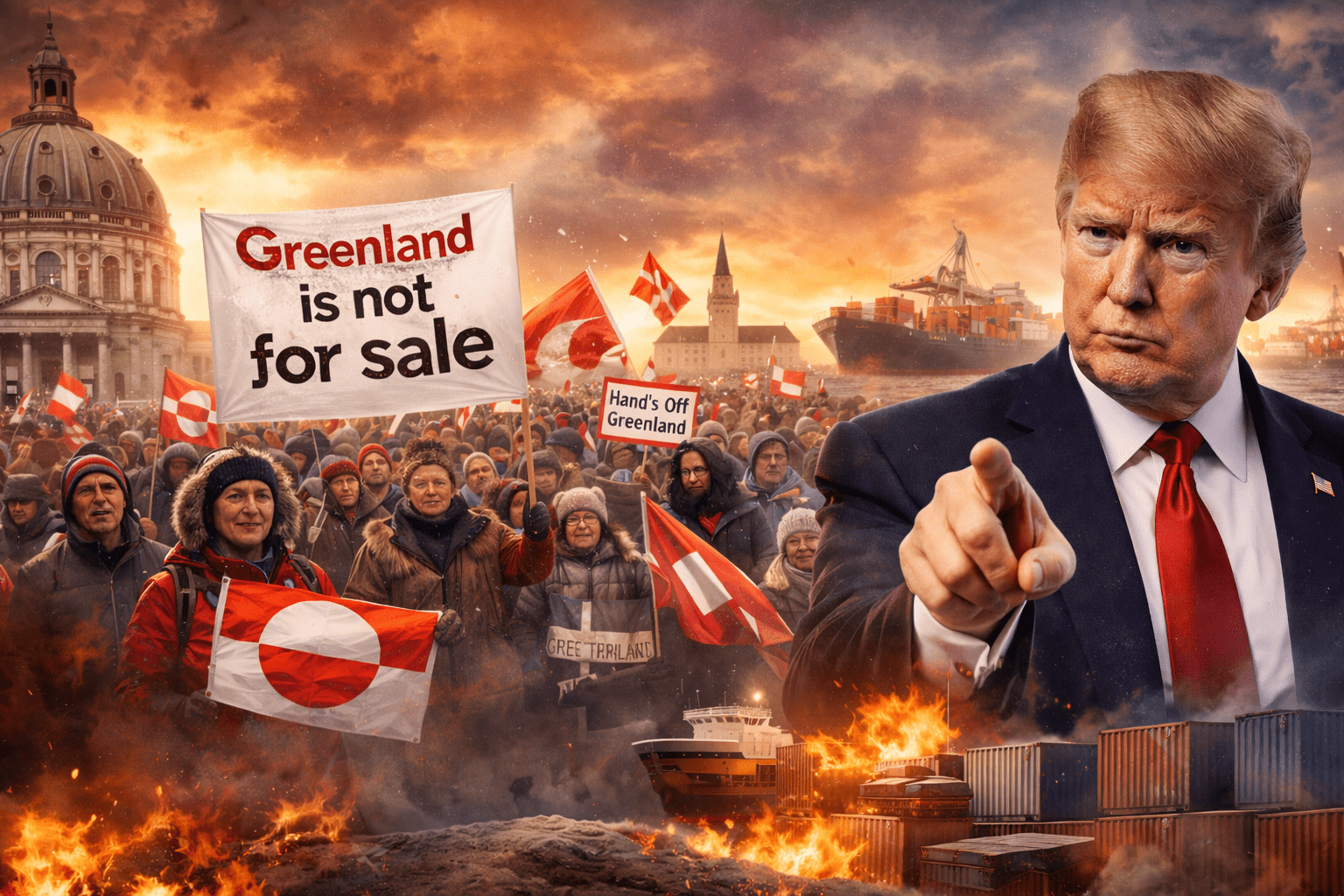
Thousands of protesters gathered across Denmark and in Nuuk, the capital of Greenland, under slogans such as “Greenland is not for sale” and “Hands Off Greenland.”
Demonstrators stressed Greenland’s right to self-determination and rejected any attempt to force a change in sovereignty through economic or political pressure. Civil society groups in Greenland warned that the territory was being drawn into a broader geopolitical confrontation against the will of its people.
European Political Backlash
UK Conservative leader Kemi Badenoch described the proposed tariffs as a “terrible idea,” warning that they would raise costs for both European and American businesses and consumers.
European officials echoed similar concerns, saying the tariffs could damage transatlantic trade relations and undermine NATO unity at a time of heightened global instability.
Former NATO secretary general Anders Fogh Rasmussen criticised Trump’s focus on Greenland, arguing that it distracted attention from more immediate global security threats, including the ongoing war in Ukraine.
Economic and Trade Impact
Trade analysts warn that if implemented, the tariffs could:
- Increase prices on European goods in the US market
- Disrupt transatlantic supply chains
- Trigger retaliatory measures from the European Union
- Deepen uncertainty in global trade already strained by geopolitical conflicts
Key sectors expected to be affected include automotive exports, industrial machinery, consumer goods, and energy-related products.
Why Greenland Matters
Greenland has gained strategic importance due to its Arctic location, expanding shipping routes, and potential access to rare earth minerals and natural resources. As climate change accelerates Arctic accessibility, competition among global powers has intensified.
What was once seen as a remote territory is now at the center of a broader struggle involving security, resources, and geopolitical influence.
What Comes Next
European Union leaders and NATO allies are expected to hold urgent consultations in the coming days. While diplomatic channels remain open, analysts warn that sustained tariff threats could push US–Europe relations into their most serious crisis in decades.
For now, Greenland has become more than a territorial question—it is a flashpoint where trade, security, and global power politics collide.
Sources: