From London Exile to Dhaka’s Power Center — Tarique Rahman Takes Charge in a Time of Crisis
After 17 years in self-imposed exile, Bangladesh’s new Prime Minister enters office with a two-thirds parliamentary mandate, sweeping reform promises — and a mountain of crises to manage. A QuickPost editorial analysis.
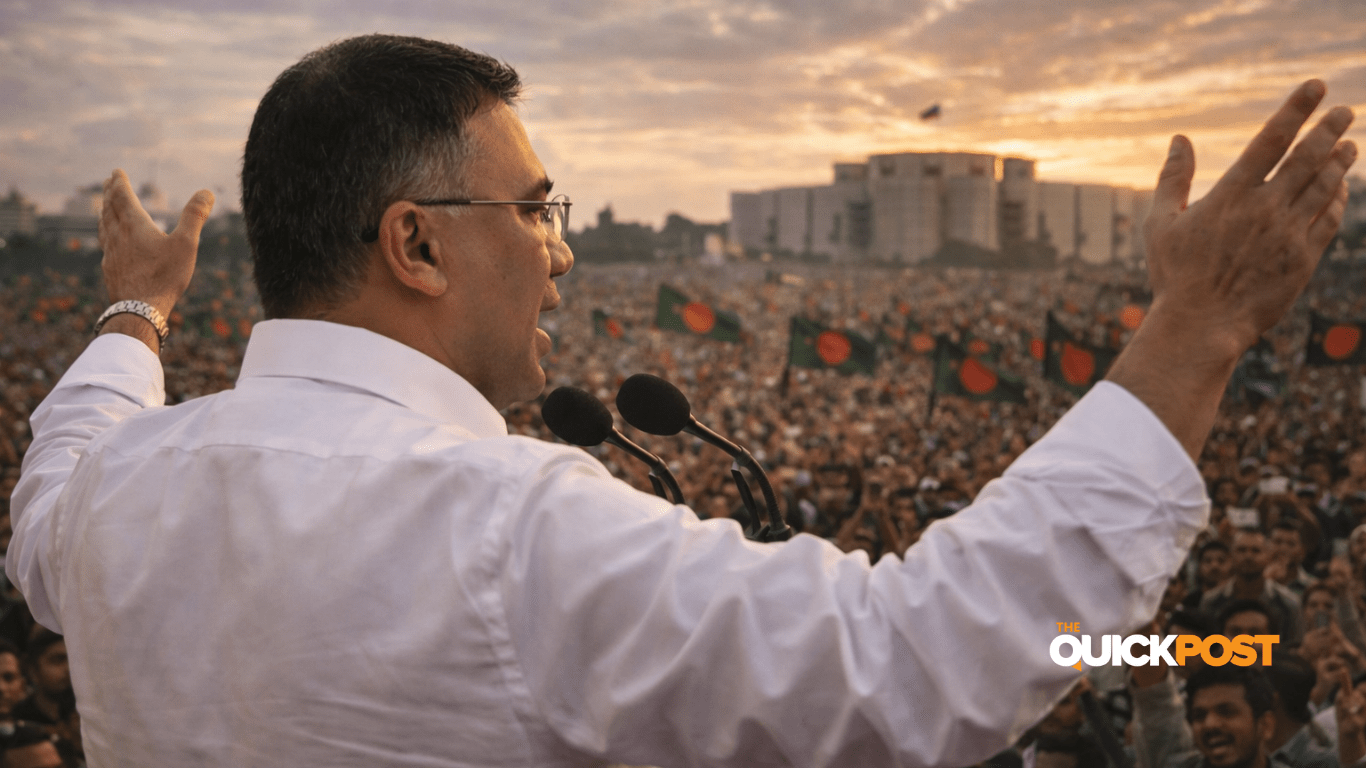
Tarique Rahman, 60, was sworn in as Bangladesh’s 11th Prime Minister on 17 February 2026 — the first male leader of the country in 35 years, and the first head of government to emerge from the historic July 2024 student uprising that ended Sheikh Hasina’s 15-year rule. Standing barefoot on Bangladeshi soil at Hazrat Shahjalal International Airport on Christmas Day 2025, raising a handful of earth in a gesture of return, Rahman set the symbolic tone for what promises to be one of the most consequential premierships in the South Asian nation’s history.
His Bangladesh Nationalist Party (BNP) secured 209 of 297 contested seats in the 13 February election — a two-thirds supermajority validated by international observers as “peacefully and competently administered,” though they cautioned that the broader political environment remained fragile, partly because the Awami League was barred from participating by judicial order. Jamaat-e-Islami, leading an 11-party alliance, won 68 seats as the main opposition. The election ran alongside a constitutional referendum that passed with roughly 65% support, introducing two-term limits for the prime minister, a bicameral parliament, and stronger judicial independence.
“Those who voted for BNP and gave it the opportunity to form the new government, those who did not vote for it, or those who did not vote for anyone at all — all have equal rights to this government.”
— Prime Minister Tarique Rahman · Inaugural Address · 17 February 2026The Road to the PMO: A Timeline
Bangladesh’s Economic Scorecard: What Tarique Inherits
Six Crises That Define Tarique’s Mandate
The 51-Point Manifesto: Core Pledges
Editorial Verdict: Why Bangladesh Needed This Moment
The question of whether Bangladesh specifically needed Tarique Rahman is distinct from the question of whether it needed a legitimate, democratically elected government after the July 2024 upheaval. On the latter, the answer is unambiguous. The 18-month Yunus-led interim administration provided stability but could not claim the electoral mandate required to implement deep structural reform. Rahman’s two-thirds majority — won in a competitive, internationally observed election — gives his government an authority that no Bangladeshi leader has possessed in decades.
The more complex question is whether Tarique Rahman — a figure who carries the weight of 17 years of exile, 84 dropped criminal cases, and the polarising legacy of his family dynasty — is the right leader for this specific moment. The evidence, so far, is mixed but cautiously optimistic. His inaugural address was notably inclusive in tone, explicitly promising equal rights to those who did not vote for him. His three immediate priorities — price control, law and order, and energy supply — are pragmatic rather than ideological. And the Family Card scheme shows a social policy instinct attuned to the reality that inflation has most damaged Bangladesh’s poorest citizens.
“The BNP should keep the grand plan in mind but target bite-sized, high-impact projects for urgent implementation.”
— Khan Ahmed Sayeed Murshid, Economist · Economic Restructuring Report · via Time Magazine, March 2026The structural challenges, however, are formidable. Bangladesh’s LDC graduation in November 2026 is perhaps the most acute near-term threat: the loss of preferential trade tariffs for garment exports — which constitute over 80% of the nation’s $55 billion export base — could fundamentally destabilise the growth model that lifted tens of millions out of poverty over two decades. The new government must simultaneously contain inflation, attract foreign direct investment to replace lost tariff advantages, repair a battered banking sector, and manage a foreign policy pivot in a neighbourhood where India, China, and the United States all have competing interests. That is an extraordinary agenda for any administration, let alone one formed by a leader only 18 months removed from exile.
Bangladesh Under Hasina vs. Tarique: The Inherited Ledger
| Indicator | Hasina Era Peak | Inherited by Tarique (2026) | Assessment |
|---|---|---|---|
| GDP Growth | 7.1% (2022) | 3.7% (2025) | Crisis-level decline |
| Inflation | 5–6% (avg) | 8.58% (Jan 2026) | Improving but elevated |
| Remittances | $21.9B (2022) | $30.3B (2025) | Record high — strong buffer |
| Democracy Index | Hybrid regime (2023) | Post-revolution transition | Competitive election held |
| Trade Privileges | Full LDC status | Graduating Nov 2026 | Critical structural risk |
| Banking Sector | Deteriorating (NPLs rising) | Crisis: liquidity shortages | Urgent intervention needed |
| Political Prisoners | Hundreds (BNP leaders) | Released post-uprising | Democratic normalisation |
| Press Freedom | Severely restricted | Improving — caution advised | Under watch |
The Path Forward: Opportunities vs. Risks
- Two-thirds majority enables deep constitutional reform without coalition friction
- Record $30.3B remittances provide critical foreign exchange buffer
- July National Charter approved — two-term limits and judicial independence now law
- Strong youth population and growing digital economy base for reform
- International goodwill: Modi, Modi, Muizzu and Pakistan all congratulated — regional reset possible
- IMF forecasts GDP growth recovery to 4.7% in 2026–27 if reforms proceed
- LDC graduation strips garment export tariff advantages — Nov 2026 deadline
- Banking sector crisis: high NPLs, liquidity shortages, possible insolvencies
- Awami League exclusion from elections risks long-term democratic legitimacy concerns
- Jamaat-e-Islami resurgence (68 seats) — Islamist influence in politics growing
- Tarique’s own controversial history: US cables, WikiLeaks, “Khamba Tarique” nickname still circulate
- No US law banning AI surveillance — Bangladesh tech policy similarly behind the curve
লন্ডনের নির্বাসন থেকে ঢাকার ক্ষমতার কেন্দ্রে — সংকটময় সময়ে দায়িত্ব নিলেন তারেক রহমান
১৭ বছরের নির্বাসন শেষে দেশে ফিরে বাংলাদেশের নতুন প্রধানমন্ত্রী দুই-তৃতীয়াংশ সংসদীয় ম্যান্ডেট এবং ব্যাপক সংস্কারের প্রতিশ্রুতি নিয়ে ক্ষমতায় এসেছেন — সামনে রয়েছে একগুচ্ছ সংকট। কুইকপোস্টের সম্পাদকীয় বিশ্লেষণ।
৬০ বছর বয়সী তারেক রহমান ১৭ ফেব্রুয়ারি ২০২৬ সালে বাংলাদেশের ১১তম প্রধানমন্ত্রী হিসেবে শপথ নিলেন — ৩৫ বছরে দেশের প্রথম পুরুষ সরকারপ্রধান এবং ২০২৪ সালের জুলাই ছাত্র অভ্যুত্থান থেকে উত্থিত প্রথম নির্বাচিত নেতা, যে অভ্যুত্থান শেখ হাসিনার ১৫ বছরের শাসনের অবসান ঘটিয়েছিল। ২৫ ডিসেম্বর ২০২৫ সালে হযরত শাহজালাল আন্তর্জাতিক বিমানবন্দরে খালি পায়ে দেশের মাটি স্পর্শ করে মাটির একমুঠো তুলে নেওয়ার প্রতীকী অঙ্গভঙ্গিতে তিনি তাঁর প্রত্যাবর্তনের স্বর নির্ধারণ করেছিলেন।
তাঁর বাংলাদেশ জাতীয়তাবাদী দল (বিএনপি) ১৩ ফেব্রুয়ারির নির্বাচনে ২৯৭ আসনের মধ্যে ২০৯টি পেয়েছে — দুই-তৃতীয়াংশ সুপারমেজরিটি। আন্তর্জাতিক পর্যবেক্ষকরা এটিকে “শান্তিপূর্ণ ও দক্ষতার সাথে পরিচালিত” বলেছেন, যদিও রাজনৈতিক পরিবেশকে “ভঙ্গুর” বলে সতর্ক করেছেন। ইসলামপন্থী জোটের নেতৃত্বে জামায়াতে ইসলামী ৬৮ আসন নিয়ে প্রধান বিরোধী দলে পরিণত হয়েছে। নির্বাচনের সাথে একই দিন অনুষ্ঠিত সাংবিধানিক গণভোটে প্রায় ৬৫% ভোটে জুলাই জাতীয় সনদ পাস হয়েছে, যাতে প্রধানমন্ত্রীর দুই মেয়াদের সীমা, দ্বিকক্ষ সংসদ এবং শক্তিশালী বিচার বিভাগীয় স্বাধীনতা অন্তর্ভুক্ত।
“যারা বিএনপিকে ভোট দিয়েছেন এবং সরকার গঠনের সুযোগ দিয়েছেন, যারা ভোট দেননি, বা যারা কাউকেই ভোট দেননি — এই সরকারে সবার সমান অধিকার রয়েছে।”
— প্রধানমন্ত্রী তারেক রহমান · শপথ গ্রহণ বক্তৃতা · ১৭ ফেব্রুয়ারি ২০২৬পিএমও পর্যন্ত যাত্রা: একটি সময়রেখা
বাংলাদেশের অর্থনৈতিক স্কোরকার্ড: তারেক কী পেলেন
তারেকের ম্যান্ডেটকে সংজ্ঞায়িত করে ছয়টি সংকট
৫১ দফা ইশতেহার: মূল প্রতিশ্রুতিসমূহ
সম্পাদকীয় মূল্যায়ন: কেন বাংলাদেশের এই মুহূর্তটি প্রয়োজন ছিল
বাংলাদেশের বিশেষভাবে তারেক রহমানকে দরকার ছিল কিনা তা একটি আলাদা প্রশ্ন। কিন্তু জুলাই ২০২৪-এর অভ্যুত্থানের পর একটি বৈধ, গণতান্ত্রিকভাবে নির্বাচিত সরকার দরকার ছিল — এ বিষয়ে কোনো সংশয় নেই। ইউনূস-নেতৃত্বাধীন অন্তর্বর্তী সরকার স্থিতিশীলতা দিয়েছিল, কিন্তু গভীর সাংগঠনিক সংস্কার বাস্তবায়নের নির্বাচনী ম্যান্ডেট ছিল না। রহমানের দুই-তৃতীয়াংশ সংখ্যাগরিষ্ঠতা তাঁর সরকারকে এমন একটি কর্তৃত্ব দেয় যা দশকের পর দশকে কোনো বাংলাদেশি নেতা পাননি।
কাঠামোগত চ্যালেঞ্জগুলো, তবে, কঠিন। নভেম্বর ২০২৬-এ বাংলাদেশের এলডিসি স্নাতক সম্ভবত সবচেয়ে তীব্র স্বল্পমেয়াদী হুমকি। পোশাক রপ্তানির অগ্রাধিকারমূলক শুল্কসুবিধা হারিয়ে গেলে — যা দেশের $৫৫ বিলিয়ন রপ্তানির ৮০%-এরও বেশি — দুই দশকে কোটি মানুষকে দারিদ্র্য থেকে মুক্ত করা প্রবৃদ্ধির মডেলটি মৌলিকভাবে অস্থিতিশীল হতে পারে।
হাসিনা বনাম তারেকের বাংলাদেশ: উত্তরাধিকারের খতিয়ান
| সূচক | হাসিনা যুগের সর্বোচ্চ | তারেকের উত্তরাধিকার (২০২৬) | মূল্যায়ন |
|---|---|---|---|
| জিডিপি প্রবৃদ্ধি | ৭.১% (২০২২) | ৩.৭% (২০২৫) | সংকটকালীন পতন |
| মূল্যস্ফীতি | ৫–৬% (গড়) | ৮.৫৮% (জানু. ২০২৬) | উন্নতি হচ্ছে, তবু উচ্চ |
| প্রবাসী আয় | $২১.৯ বিলিয়ন (২০২২) | $৩০.৩ বিলিয়ন (২০২৫) | রেকর্ড উচ্চতা |
| গণতন্ত্র | হাইব্রিড শাসন (২০২৩) | বিপ্লব-পরবর্তী রূপান্তর | প্রতিযোগিতামূলক নির্বাচন |
| বাণিজ্য সুবিধা | পূর্ণ এলডিসি মর্যাদা | নভে. ২০২৬-এ স্নাতক | গুরুত্বপূর্ণ কাঠামোগত ঝুঁকি |
| ব্যাংকিং খাত | অবনতিশীল (খেলাপি বাড়ছে) | সংকট: তারল্য ঘাটতি | জরুরি হস্তক্ষেপ প্রয়োজন |
| রাজবন্দী | শত শত (বিএনপি নেতা) | অভ্যুত্থানের পর মুক্তি | গণতান্ত্রিক স্বাভাবিকতা |
| সংবাদমাধ্যমের স্বাধীনতা | মারাত্মকভাবে সীমিত | উন্নতি হচ্ছে — সতর্কতা প্রয়োজন | পর্যবেক্ষণে |